
Publications
Academic dissertations
Emilie Sigvardt, MD
- PhD thesis
- University of Copenhagen
- September 10, 2026
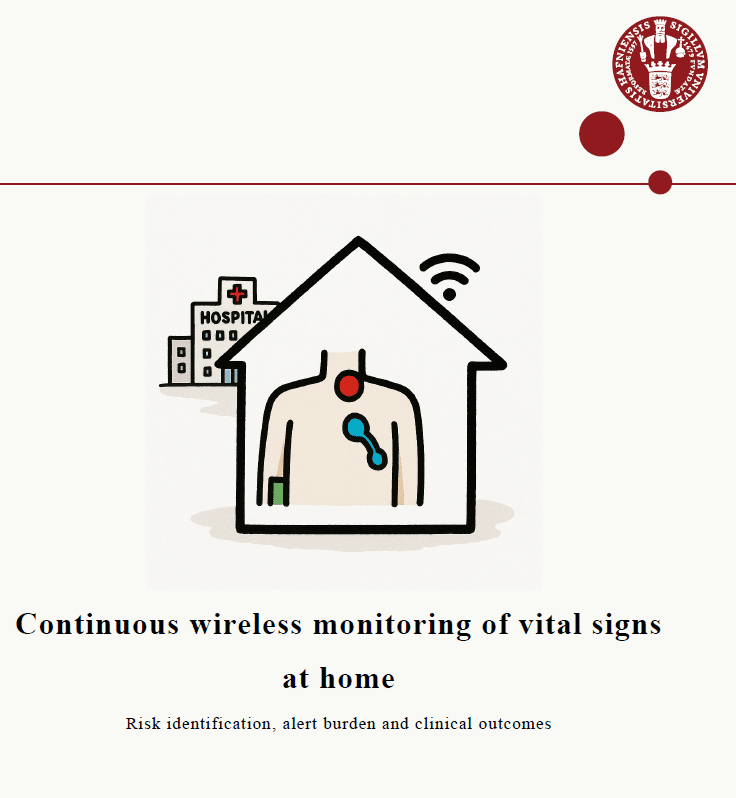
Continuous wireless monitoring of vital signs at home
The Danish healthcare system is increasingly challenged by rising life expectancy and the growing prevalence of chronic diseases. To ensure sustainable patient care, a shift from hospitals to home settings is needed, the so-called Hospital-at-Home, including both treatments and monitoring. While in-hospital alarm systems that use continuous wireless monitoring of vital signs are associated with improved clinical outcomes, evidence for such technologies in home settings remains limited.
Information on vital sign deviations at home is fundamental to improving clinical outcomes outside the traditional hospital setting. Important steps to enable this include identifying high-risk patients who would benefit most and analysing which vital sign deviations are most strongly associated with subsequent clinical outcomes. Importantly, safe implementation also requires attention to the entire alarm chain, including how alarms are received and acted upon.
Katja Kjær Grønbæk, MD

- PhD thesis
- University of Copenhagen
- December 4, 2024
Continuous wireless monitoring of vital signs in acutely admitted medical patients
Patients acutely admitted to medical wards are at significant risk of clinical deterioration or adverse events.
To address this, most hospitals have implemented protocols to monitor vital signs effectively, aiming to
detect early signs of deterioration and enable timely interventions before the condition worsens. These
protocols rely heavily on monitoring vital signs such as heart rate (HR), peripheral oxygen saturation
(SpO2), blood pressure (BP), temperature (TP), and respiratory frequency (RF). This approach is based on
evidence showing that abnormalities in vital signs often precede events like in-hospital cardiac arrest,
unplanned intensive care unit (ICU) admissions, and mortality.
Currently, the standard of care for monitoring vital signs in Denmark and many other regions involves
manual, intermittent measurements within the UK-developed National Early Warning Score (NEWS)
framework.
Søren Straarup Rasmussen, MSc

- PhD thesis
- University of Copenhagen
- October 26, 2023
Automatic Interpretation of Vital Signs for Detecting Physiological Deterioration
While technological advances in recent years have increased the use of wireless biosensors for
monitoring biological signals for a range of different uses, the majority of hospitalized patients
still rely on manual measurements for medical staff to track their physiological condition. How
ever, systems for vital signs monitoring are now entering the market with the aim to improve
patient safety and care at hospitals. These systems will change the paradigm of patient monitoring
by introducing temporal and timely data in a resolution not previously adapted at general wards.
With the increasing volume of biological signals, the one question to answer is: how are these to
be analyzed and used to identify early signs of deterioration? By using unambiguous biosensors
on patients during their hospitalization, we aim to explore methods for analyzing the signals ob
tained given the challenges they entail, i.e. obtaining proper labels, working with missing data,
and identifying early markers of physiological deterioration.
As much of the data recorded during vital signs monitoring is not easily labeled for supervised
learning, we explore the use of a Deep Generative Model to utilize unlabeled and labeled data
in a semi-supervised manner.
Nasser H. Awada, MD
- PhD thesis
- University of Copenhagen
- June 21, 2023
Acute and Late Onset Postoperative Cognitive Impairment After Fast-Track Surgery – Exploring the Pattern of Occurence and Related Risk Factors
A significant proportion of patients experience cognitive impairment after anesthesia and surgery1. Regardless of a proven relation between PCI and increased postoperative morbidity and mortality, most cases go unrecognized in clinical settings, partly due to the subtle symptomatology of the conditions2. PCI can be sub-classified into a time-dependent range of overlapping conditions with Emergence delirium (ED) occurring during the immediate postoperative period in the post-anesthesia care unit (PACU), postoperative delirium (POD) during the first postoperative days, and postoperative cognitive dysfunction (POCD) in days to months postoperatively. Furthermore, delirium exists in three different motoric subtypes, which are hyperactive, hypoactive, or mixed-type delirium3.
Jesper Mølgaard, MD
- PhD thesis
- University of Copenhagen
- June 16, 2023
Interpreting Postoperative Physiology Prior to Complications Using Continuous Vital Sign Monitoring
After major surgery, patients are at a high risk of various complications. The
current standard of care for postoperative patients with regard to vital sign
measurements is the intermittent monitoring of vital sign values such as heart
rate (HR), blood pressure (BP), peripheral oxygen saturation (SpO2), and
respiration frequency (RF). The model used in many health systems around the
world is an adaptation of the British National Early Warning Score (NEWS)
system. There is evidence to suggest that NEWS is able to identify patients with
impending complications hours before they are recognized clinically, however,
this has paradoxically not been shown to reduce ward morbidity and mortality.
Continuous wireless vital sign monitoring and alerting systems (CVSMA) is a
cutting-edge technology that has the potential to improve surgical outcomes,
but so far, very little knowledge exists on how to interpret continuous vital
signs, especially so outside of the intensive care unit.
Several problems need to be solved before CVSMA systems can be expected to
be a valuable tool in the care of postoperative patients.
Camilla Haahr-Raunkjær, MD

- PhD thesis
- University of Copenhagen
- September 16, 2022
Wireless Assessment of Respiratory and Circulatory Distress in Postoperative Patients and Patients at a Rehabilitation Center
Based on my online grocery shopping, Google knows my favorite dish before I do; my phone tells me when
I’ve had enough sleep; I can track my kids’ activity while I’m at work; and it is possible to perform surgery on
a patient in Denmark while the surgeon is located in another country [2]. For decades, technology has
advanced rapidly, making our lives easier – and more complex in some ways. But despite technological
advances and ongoing research, it is still challenging to detect patient deterioration in general hospital wards,
avoiding severe complications.
It is estimated that more than 313 million surgeries are performed each year [3], and both relatives and
patients are relieved and assume that the most dangerous part is over when surgery is completed.
Unfortunately, this belief is frequently incorrect as mortality 30 days after surgery is 100 times more common
than intraoperative mortality, maybe because up to 30% of all patients undergoing major surgery will develop
a complication within 30 days [4–6].
While surgical techniques and intraoperative treatment and care are constantly evolving, evaluated, and
improved to reduce intraoperative mortality, much less emphasis has been placed on the postoperative
period.
Mikkel Elvekjær, MD
- PhD thesis
- University of Copenhagen
- May 6, 2021
Wireless Assessment of Respiratory and Circulatory Distress in Chronic Obstructive Pulmonary Disease with Special Emphasis on Physiological Abnormalities, Validation and Patient Outcomes in Acute Exacerbation
Patients who are hospitalized trust they are entering a safe place. They believe they are in the
optimal place for prompt action, should their condition deteriorate further. However, there are
data suggesting that this is often not the case. Unrecognized physiological instability can
progress to severe complications, making it essential that impending deterioration is
detected early. Current standard monitoring relies on intermittent observations and concern
exists that these systems do not perform as well as expected, in particular in patients with
chronic obstructive pulmonary disease (COPD). Patients admitted with acute exacerbation of
COPD (AECOPD) have high mortality rates and may deteriorate suddenly. Wireless monitoring
systems can measure vital signs continuously and this may improve patient care by permitting
physiological abnormalities to be detected earlier. This thesis aimed to investigate vital sign
abnormalities in the AECOPD setting (Study 1) and to evaluate the accuracy of wireless devices
(Study 2). We also aimed to investigate the association between frequency and duration of vital
sign abnormalities and subsequent serious adverse events (SAEs) (Study 3).
Peer-reviewed publications
Publication first author
More
Publication journal
More
Publication year
Continuous Vital Sign Monitoring at the Surgical Ward for Improved Outcomes After Major Noncardiac Surgery: A Randomized Clinical Trial
- Mølgaard J. et al
- Anesthesia & Analgesia (2025)
Katja Kjær Grønbæk, Søren Straarup Rasmussen, Jonas Peter Eiberg, Lars N. Jørgensen, Michael P. Achiam, Malene Rohrsted, Upender M. Singh, Tuyet-Hoa Hoang, Marlene Søgaard, Christian S. Meyhoff, Eske K. Aasvang
Nadir heart rate as a novel risk marker of postoperative complications – A propensity matched analysis
- Mølgaard J. et al.
- Sleep Medicine (2025)
Leon Mayer, Søren Straarup Rasmussen, Camilla Haahr-Raunkjær, Michael Patrick Achiam, Lars N. Jørgensen, Christian S. Meyhoff, Eske K. Aasvang
Frequency of emergency medical service contacts after hospital admissions
- Sigvardt E. et al
- Internal and Emergency Medicine (2025)
Markus Harboe Olsen, Fredrik Folke, Eske K. Aasvang, Christian S. Meyhoff
In reply to: Frequency, extent, cumulative time and trend of postoperative vital sign deviation: The elements for a (remote) continuous early warning system
- Jensen M.S.V. et al.
- Acta Anaesthesiologica Scandinavica (2025)
Christian S. Meyhoff, Eske K. Aasvang
Time to detection of serious adverse events by continuous vital sign monitoring versus clinical practice
- Jensen M.S.V. et al.
- Acta Anaesthesiologica Scandinavica (2025)
Vibeke Ramsgaard Eriksen, Søren Straarup Rasmussen, Christian S. Meyhoff, Eske K. Aasvang
Discrepancies between Promised and Actual AI Capabilities in the Continuous Vital Sign Monitoring of In-Hospital Patients: A Review of the Current Evidence
- Aagaard N.
- Sensors (Basel, Switzerland) (2024)
Eske K. Aasvang, Christian S. Meyhoff
Estimation of the maximum potential cost saving from reducing serious adverse events in hospitalized patients
- Larsen A.T. et al.
- Acta Anaesthesiologica Scandinavica (2024)
Liza Sopina, Eske K. Aasvang, Christian S. Meyhoff, Søren Rud Kristensen, Jakob Kjellberg
Role-reversal simulation training to enhance performance and reduce stress of endovascular scrub nurses in the operating room
- Skov R.A.C. et al.
- Current Problems in Surgery (2024)
Jonathan Lawaetz, Lars Konge, Timothy Andrew Resch, Eske K. Aasvang, Christian S. Meyhoff, Lise Westerlin, Mogens Kærsgaard Jensen, Jonas Peter Eiberg
Prognostic value of heart rate variability for risk of serious adverse events in continuously monitored hospital patients
- Aagaard N. et al.
- Journal of Clinical Monitoring and Computing (2024)
Markus Harboe Olsen, Oliver Wiik Rasmussen, Katja Kjær Grønbæk, Jesper Mølgaard, Camilla Haahr-Raunkjaer, Mikkel Elvekjaer, Eske K. Aasvang, Christian S. Meyhoff
Comparison of Wireless Continuous Axillary and Core Temperature Measurement after Major Surgery
- Nathansen A.B. et al.
- Sensors (Basel, Switzerland) (2024)
Jesper Mølgaard, Christian S. Meyhoff, Eske K. Aasvang
Wireless continuous single-lead ST-segment monitoring to detect new-onset myocardial injury at the general ward – An exploratory subanalysis
- Starling J.A.K. et al.
- Acta Anaesthesiologica Scandinavica (2024)
Camilla Haahr-Raunkjaer, Søren S. Rasmussen, Luna Ekenberg, Frederik Cornelius Loft, Christian S. Meyhoff, Eske K. Aasvang
Excessive Oxygen Administration in High-Risk Patients Admitted to Medical and Surgical Wards Monitored by Wireless Pulse Oximeter
- Mathar C.E. et al.
- Sensors (2024)
Camilla Haahr-Raunkjær, Mikkel Elvekjær, Ying Gu, Claire P. Holm, Michael P. Achiam, Lars N. Jørgensen, Eske K. Aasvang, Christian S. Meyhoff
The effect of technical filtering and clinical criteria on alert rates from continuous vital sign monitoring in the general ward
- Kjærgaard K. et al.
- Hospital practice (2023)
Jesper Mølgaard, Søren M. Rasmussen, Christian S. Meyhoff, Eske K. Aasvang
Continuous Monitoring of Vital Signs After Hospital Discharge: A Feasibility Study
- Songthawornpong N. et al.
- Patient Safety (2023)
Thivya Vijayakumar, Marie Said Vang Jensen, Mikkel Elvekjaer, Helge B. D. Sørensen, Eske K. Aasvang, Christian S. Meyhoff, Vibeke R. Eriksen
The association between vital signs abnormalities during postanaesthesia care unit stay and deterioration in the general ward following major abdominal cancer surgery assessed by continuous wireless monitoring
- Skovbye M. et al.
- Critical care and resuscitation : journal of the Australasian Academy of Critical Care Medicine (2023)
Jesper Mølgaard, Søren M. Rasmussen, Helge B.D. Sørensen, Christian S. Meyhoff, Eske K. Aasvang
The future of postoperative vital sign monitoring in general wards: improving patient safety through continuous artificial intelligence-enabled alert formation and reduction
- Aasvang E.K., & Meyhoff C.S.
- Current opinion in anaesthesiology (2023)
Workload associated with manual assessment of vital signs as compared with continuous wireless monitoring
- Sigvardt E. et al.
- Acta anaesthesiologica Scandinavica (2023)
Katja Kjær Grønbæk, Mia Lind Jepsen, Marlene Søgaard, Louise Haahr, Ana Inácio, Eske K. Aasvang, Christian S. Meyhoff
Deviating vital signs in continuous monitoring prior to discharge and risk of readmission: an observational study
- Songthawornpong N. et al.
- Internal and emergency medicine (2023)
Mikkel Elvekjaer, Jesper Mølgaard, Søren M. Rasmussen, Christian S. Meyhoff, Eske K. Aasvang, Vibeke R. Eriksen
Quantifying physiological stability in the general ward using continuous vital signs monitoring: the circadian kernel density estimator
- Rasmussen S.S. et al.
- Journal of clinical monitoring and computing (2023)
Katja Kjær Grønbæk, Jesper Mølgaard, Camilla Haahr-Raunkjær, Christian S. Meyhoff, Eske K. Aasvang, Helge B. D. Sørensen
Wireless Single-Lead versus Standard 12-Lead ECG, for ST-Segment Deviation during Adenosine Cardiac Stress Scintigraphy
- Fabricius Ekenberg L. et al.
- Sensors (Basel, Switzerland) (2023)
Dan Eik Høfsten , Søren M. Rasmussen, Jesper Mølgaard, Philip Hasbak, Helge B. D. Sørensen, Christian S. Meyhoff, Eske K. Aasvang
Continuous monitoring is superior to manual measurements in detecting vital sign deviations in patients with COVID-19
- Grønbaek K.K. et al.
- Acta anaesthesiologica Scandinavica (2023)
Søren Møller Rasmussen, Natasha Hemicke Langer, Mette Vincentz, Anne-Britt Oxbøll, Marlene Søgaard, Hussein Nasser Awada, Tomas O. Jensen, Magnus Thorsten Jensen, Helge B. D. Sørensen, Eske K. Aasvang, Christian S. Meyhoff
Agreement between standard and continuous wireless vital sign measurements after major abdominal surgery: a clinical comparison stud
- Haahr-Raunkjaer, C. et al.
- Physiological measuremen (2023)
Magnus Skovbye, Søren M. Rasmussen, Mikkel Elvekjaer, Helge B. D. Sørensen, Christian S. Meyhoff, Eske K. Aasvang
Continuous wireless pre- and postoperative vital sign monitoring reveal new, severe desaturations after vascular surgery
- Mølgaard J. et al.
- Acta anaesthesiologica Scandinavica (2023)
Søren Straarup Rasmussen, Jonas Eiberg, Helge B. D. Sørensen, Christian S. Meyhoff, Eske K. Aasvang
The impact of continuous wireless monitoring on adverse device effects in medical and surgical wards: a review of current evidence
- Aagaard N. et al.
- Journal of clinical monitoring and computing (2023)
Arendse Tange Larsen, Eske K. Aasvang, Christian S. Meyhoff
Prediction of Serious Adverse Events from Nighttime Vital Signs Values
- Mayer L. et al.
- 44th Annual International Conference of the IEEE Engineering in Medicine and Biology Society (2022)
Søren M. Rasmussen, Jesper Mølgaard, Ying Gu, Eske K. Aasvang, Christian S. Meyhoff, Helge B. D. Sørensen
Forecasting of Continuous Vital Sign Using Multivariate Auto-Regressive Models
- Rasmussen, S. M. et al.
- 44th Annual International Conference of the IEEE Engineering in Medicine and Biology Society (2022)
Jesper Mølgaard, Camilla Haahr-Raunkjaer, Christian S. Meyhoff, Eske K. Aasvang, Helge B. D. Sørensen
Prediction of serious outcomes based on continuous vital sign monitoring of high-risk patients
- Kristinsson, Æ. Ö. et al.
- Computers in biology and medicine (2022)
Ying Gu, Søren M. Rasmussen, Jesper Mølgaard, Camilla Haahr-Raunkjær, Christian S. Meyhoff, Eske K. Aasvang, Helge B. D. Sørensen
Clinical impact of vital sign abnormalities in patients admitted with acute exacerbation of chronic obstructive pulmonary disease: an observational study using continuous wireless monitoring
- Elvekjær M. et al.
- Internal and Emergency Medicine (2022)
Søren M. Rasmussen, Katja Kjær Grønbæk, Celeste M. Porsbjerg, Jens-Ulrik Jensen, Camilla Haahr-Raunkjær, Jesper Mølgaard, Marlene Søgaard, Helge B. D. Sørensen, Eske K. Aasvang, Christian S. Meyhoff
Continuously monitored vital signs for detection of myocardial injury in high-risk patients – An observational study
- Loft F.C. et al.
- Acta Anaesthesiol Scandinavia (2022)
Søren M. Rasmussen, Mikkel Elvekjaer, Camilla Haahr-Raunkjaer, Helge B. D. Sørensen, Eske K. Aasvang, Christian S. Meyhoff, WARD-Project Group
Wireless Single-Lead ECG Monitoring to Detect New-Onset Postoperative Atrial Fibrillation in Patients After Major Noncardiac Surgery: A Prospective Observational Study
- Jokinen J.D.V. et al.
- Anesthesia and analgesia (2022)
Christian J. Carlsson, Søren M. Rasmussen, Olav W. Nielsen, Bo G. Winkel, Lars N. Jørgensen, Michael P. Achiam, Jesper Mølgaard, Helge B. D. Sørensen, Eske K. Aasvang, Christian S. Meyhoff, WARD Project Group
Continuous monitoring of vital sign abnormalities; association to clinical complications in 500 postoperative patients
- Haahr-Raunkjaer C. et al.
- Acta Anaesthesiol Scandinavia (2022)
Jesper Mølgaard, Mikkel Elvekjaer, Søren M. Rasmussen, Michael P. Achiam, Lars N. Jørgensen, Mette I. V. Søgaard, Katja Kjær Grønbæk, Anne-Britt Oxbøll, Helge B. D. Sørensen, Christian S. Meyhoff, Eske K. Aasvang
Semi-Supervised Analysis of the Electrocardiogram Using Deep Generative Models
- Rasmussen S.M. et al.
- 43rd Annual International Conference of the IEEE Engineering in Medicine & Biology Society (EMBC) (2021)
Malte E. K. Jensen, Christian S. Meyhoff, Eske K. Aasvang, Helge B. D. Sørensen
Prediction of severe adverse event from vital signs for post-operative patients
- Gu Y. et al.
- 43rd Annual International Conference of the IEEE Engineering in Medicine & Biology Society (EMBC) (2021)
Søren M. Rasmussen, Jesper Mølgaard, Camilla Haahr-Raunkjar, Christian S. Meyhoff, Eske K. Aasvang, Helge B. D. Sørensen
Continuous Glucose Monitoring Reveals Perioperative Hypoglycemia in Most Patients With Diabetes Undergoing Major Surgery
- Carlsson C. et al.
- Annals of Surgery (2021)
Kirsten Nørgaard, Anne-Britt Oxbøll, Mette I.V. Søgaard, Michael P. Achiam, Lars N. Jørgensen, Jonas P. Eiberg, Henrik Palm, Helge B. D. Sørensen, Christian S. Meyhoff, Eske K. Aasvang
Agreement Between Transcutaneous Monitoring and Arterial Blood Gases During COPD Exacerbation
- Sørensen K.M. et al.
- Respir Care. (2021)
Rebecca V. Leicht, Christian J. Carlsson, Mikkel Elvekjaer, Celeste Porsbjerg, Eske K. Aasvang, Christian S. Meyhoff
Agreement between wireless and standard measurements of vital signs in acute exacerbation of chronic obstructive pulmonary disease: a clinical validation study
- Elvekjær M. et al.
- Physiological Measurement (2021)
Christian Jakob Carlsson, Søren Møller Rasmussen, Celeste M. Porsbjerg, Katja Kjær Grønbæk, Camilla Haahr-Raunkjær, Helge B. D. Sørensen, Eske K. Aasvang, Christian S. Meyhoff, WARD-Project Group
Continuous peripheral perfusion index in patients admitted to hospital wards – an observational study
- Rasmussen P.S. et al.
- Acta Anaesthesiol Scandinavia (2020)
Eske K. Aasvang, Rasmus M. Olsen, Camilla Haahr-Raunkjaer, Mikkel Elvekjaer, Helge B. D. Sørensen, Christian S. Meyhoff
Physiological Abnormalities in Patients Admitted With Acute Exacerbation of COPD: An Observational Study With Continuous Monitoring
- Elvekjaer M. et al.
- Journal of clinical monitoring and computing (2020)
Eske K. Aasvang, Rasmus M. Olsen, Helge B. D. Sørensen, Celeste M. Porsbjerg, Jens-Ulrik Jensen, Camilla Haahr-Raunkjær, Christian S. Meyhoff, WARD-Project Group
Towards an Automated Multimodal Clinical Decision Support System at the Post Anesthesia Care Unit
- Olsen R.M. et al.
- Computers in biology and medicine (2018)
Eske K. Aasvang, Christian S. Meyhoff, Helge B. D. Sørensen
Continuous Vital Sign Monitoring After Major Abdominal surgery-Quantification of Micro Events
- Duus C.L. et al.
- Acta Anaesthesiol Scandinavia (2018)
Eske K. Aasvang, R. M. Olsen, Helge B. D. Sørensen, L. N. Jørgensen 4, M. P. Achiam, Christian S. Meyhoff
Technological Aided Assessment of the Acutely Ill Patient – The Case of Postoperative Complications
- Haahr-Raunkjær C. et al.
- European journal of internal medicine (2017)
Christian S. Meyhoff, Helge B. D. Sørensen, R. M. Olsen, Eske K. Aasvang
Associations between clinical interventions and transcutaneous blood gas values in postoperative patients
- Thy SA. et al.
- Journal of Clinical Monitoring and Computing (2023)
Andreas O. Johansen, André Thy, Henrik H. Sørensen, Jesper Mølgaard, Nicolai B. Foss, Palle Toft, Christian S. Meyhoff, Eske K. Aasvang
Postoperative Delirium and the Association to Continuously Monitored Severe Deviations of Vital Signs at the General Ward After Major Abdominal Surgery
- Awada HN. et al.
- Acta Anaesthesiologica Scandinavica (2026)
Camilla Haahr-Raunkjær, Jesper Mølgaard, Søren Møller Rasmussen, Christian S. Meyhoff, Eske K. Aasvang
Continuous Glucose Monitoring With Real-Time Alerts to Achieve Glycaemic Control in Surgical Patients With Diabetes
- Pedersen C. et al.
- Acta Anaesthesiologica Scandinavica (2026)
Annelotte Philipsen, Kirsten Nørgaard, Eske K. Aasvang, Christian S. Meyhoff
Continuous glucose monitoring for diabetes mellitus in the perioperative and intensive care setting: a prospective observational validation study
- Pedersen C. et al.
- British Journal of Anaesthesia (2026)
Aslak B. Johansen, Annelotte Philipsen, Kirsten Nørgaard, Theis S. Itenov, Jonas Peter Eiberg, Lars N. Jørgensen, Henrik Palm, Christian S. Meyhoff, Eske K. Aasvang
Impact of postoperative in-hospital continuous vital sign monitoring on healthcare costs, resource utilization and labor market outcomes
- Larsen AT. et al.
- The European Journal of Health Economics (2026)
Liza Sopina, Jesper Mølgaard, Eske K. Aasvang, Christian S. Meyhoff, Jakob Kjellberg, Søren Rud Kristensen
Alert burden when monitoring patients’ vital signs continuously at home
- Sigvardt E. et al.
- Journal of Clinical Monitoring and Computing (2026)
Jesper Mølgaard, Hanne Nygaard, Christian S. Meyhoff, Eske K. Aasvang
Transcutaneous blood gas monitoring and tissue perfusion during common femoral thromboendarterectomy
- Sigvardt E. et al.
- Scandinavian Journal of Clinical and Laboratory Investigation (2022)
Søren Møller Rasmussen, Jonas Peter Eiberg, Helge B. D. Sørensen, Christian S. Meyhoff, Eske K. Aasvang
Deviations in continuously monitored electrodermal activity before severe clinical complications: a clinical prospective observational explorative cohort study
- Johansen AO et al.
- Journal of Clinical Monitoring and Computing (2023)
Jesper Mølgaard, Søren Straarup Rasmussen, Ying Gu, Katja Kjær Grønbæk, Helge B. D. Sørensen, Eske K. Aasvang & Christian S. Meyhoff
Assessing the Expected Costs of Continuous Remote Monitoring for Post-Discharge Home Use and the Readmission Reduction Required to Achieve Cost Neutrality
- Larsen AT. et al.
- PharmacoEconomics - Open (2026)
Liza Sopina, Eske K. Aasvang, Christian S. Meyhoff, Søren Rud Kristensen & Jakob Kjellberg
Continuous Wireless Vital Sign Sensors for Detecting Severe Deviations at a Transitional Care Facility-An Observational Feasibility Study
- Mølgaard J. et al
- Sensors (2025)
Camilla Haahr-Raunkjaer, Søren Straarup Rasmussen, Loraine Villacorte Andersen, Christian S. Meyhoff, Eske K. Aasvang
Risk factors for vital sign deviations in acutely admitted medical patients – an exploratory analysis
- Grønbaek K.K. et al.
- Hospital practice (2025)
Jesper Mølgaard, Kasper Mørk Sørensen, Emilie Sigvardt, Mikkel Elvekjær, Eske K. Aasvang, Christian S. Meyhoff
Effects of Hyperoxia and Antioxidants on Mortality, Hospital Admissions, and Myocardial Infarction After Noncardiac Surgery: 1-Year Follow-Up of a Randomized Controlled Trial
- Loft F.C. et al.
- Acta Anaesthesiologica Scandinavica (2025)
Cecilie Holse, Eske K. Aasvang, Morten Vester-Andersen, Lars S. Rasmussen, Lars N. Jørgensen, Christian S. Meyhoff
Vital signs during complication-free recovery after major surgery: a retrospective analysis
- Guldager CH. et al.
- Journal of Clinical Monitoring and Computing (2026)
Jesper Mølgaard, Helle K. Hansen, Christian S. Meyhoff, Eske K. Aasvang
Prognostic Value of Traditional and Optimised Vital Sign Thresholds for Risk of Serious Adverse Events in Continuously Monitored Hospitalised Patients
- Aagaard N. et al.
- Sensors (2026)
Markus Harboe Olsen, Jesper Mølgaard, Katja Kjær Grønbæk, Mikkel Elvekjær, Eske K. Aasvang, Christian S. Meyhoff
Machine learning improves classification of serious adverse events compared to thresholdbased continuous vital sign monitoring alerts
- Pedersen N.K. et al.
- Scientific Reports (2026)
Andreas Hasselriis, Carl I. Askehave, Jesper Mølgaard, Katja Kjær Grønbæk, Søren Straarup Rasmussen, Christian S. Meyhoff, Troels C. Petersen, Eske K. Aasvang